This is a developing story of a LinkedIn member, Olga Kellen, research professional, translator, marketer, writer, Citizen of the World. There are postings about LinkedIn, its features and also about Olga Kellen's personal development, research and reports on a variety of topics including self-publishing and Internet marketing, her writing and marketing experience.
All the six previous books of the series on the topic on marketing and selling real estate internationally are $9.95 each.
Most of the books on Amazon in Global Marketing Department are pretty expensive - probably for a reason, so I have decided to stay somewhere at the bottom of the pricing range, without going too much below.
Alas, some commentators on LinkedIn say that it's too expensive for a rather short e-book on a rather narrow topic (hmm...) and advise the price of $2.99 to have more sales for a low price, but they think the total will be more...
Well, I believe that pricing too low would diminish the value of the professional knowledge and suggest that there is nothing useful in a book even from the point of view of the author.
Anyway, the new e-book *How to Use Free Online Translation in Real Estate Business* is for people who are looking for the free stuff on the internet and thus I have decided to price it at the "everybody's favorite" $2.99 as an experiment - to see whether the low price would bring more sales and the larger total as a result.
I'm a new Amazon Kindle publisher with the *E-Series: How to Beat Your Competition Selling Real Estate to Foreign Buyers* at http://www.amazon.com/author/olgakellen
There is a program offered to publishers called Kindle Unlimited to which publishers can subscribe. The program allows Amazon readers who pay monthly subscription fees to Amazon to download any book that is in the program free of charge. Publishers are getting paid for the number of pages that were actually read, and the source of such payments is some fund created from the subscription fees.
Amazon makes this program attractive to the publishers saying:
"Here are some examples of how it would work if the fund was $10M and 100,000,000 total pages were read in the month:
The author of a 100 page book that was borrowed and read completely 100 times would earn $1,000 ($10 million multiplied by 10,000 pages for this author divided by 100,000,000 total pages)."
Looks good? Pays approximately 10 cents per page read... Of course, I'm in!
Then I started seeing payments like 20 cents on my Amazon reports and thought: what is that? was somebody so unhappy with my text that they stopped reading after 2 pages??? NO!!!
I went digging through Amazon forums and discovered from other authors that in reality payments per page to publishers in the program are about one half of a cent instead of 10 cents!
So, as you already guess, I'm out as soon as my mandatory 3 months in the program to which I signed are over!
If you are a subscriber to Kindle Unlimited, hurry up to download my e-books on international real estate sales free http://www.amazon.com/author/olgakellen , later on they will be available only for buying...
It was lots of fun to write this blog 8 years ago... I was new on LinkedIn and still rather new in the self-publishing arena, and this blog was about these two adventures.
Many things have happened since then:
- My LinkedIn profile http://www.linkedin.com/in/olgakellen is still alive and well, but long ago I stopped doing anything to specifically grow my network as at some point it had taken care of itself. I've got several marketing and translation clients from LI, but do not spend time on the site anymore.
- 8 years ago I started my professional translation website http://www.english-and-russian.com/ and that was the reason that I abandoned anything else and applied all my time and efforts to this project. Pretty soon the site turned its course and became a marketing-to-Russians venue with the accent on selling international real estate to Russian buyers: http://www.english-and-russian.com/find-russian-buyers.html . The site got up to the top positions in Google for the keywords like "Russian buyers", "Russian brokers", "Russian real estate agents" and other similar terms.
- Having acquired lots of experience in international marketing of real estate and written lots of texts in this business area I just recently started to sort it all out and create e-books on various topics in the field: http://www.english-and-russian.com/foreign-investors.html .
- So, we may actually say that I'm back to self-publishing, this time on Amazon Kindle: http://www.amazon.com/author/olgakellen . This is the new *E-Series:
How to Beat Your Competition Selling Real Estate to Foreign Buyers*. The E-Series will eventually summarize All-One-Has-to-Know
to successfully market and sell real estate to international buyers. Each
e-book centers on a particular aspect of marketing and selling properties to
international buyers.
-
The
E-Series so far consists of the following four books (click on each cover image to go to the books' Amazon pages):
Book 1. *How to Find the Best Foreign Realtors and Make
Your Offer of Cooperation in Sale Irresistible to Them* is a complete guide for
marketing and selling international properties with the help of foreign
realtors.
Book 2. *How to Efficiently Advertise Your Property for
Sale Internationally* is about the option of selling properties by marketing
directly to potential foreign buyers and conveys the best cost-effective ways
of direct advertising to the general buying public in a foreign country where
you want to find a buyer for you property.
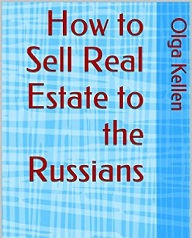
Book 3. *How to Sell Real Estate to the Russians*is
the expert advice for realtors, developers and private property sellers from
all over the world who are looking specifically for the Russian buyers to
broaden their buying pool and thus improve their real estate sales.
Book 4.
*How to Plan and Budget for Success in International Property Sales* is about
creating the most cost-effective marketing plan based on any marketing budget
for any property for sale to the foreign real estate buyers.
- The time has come to start MARKETING my new babies and this is fun again.
--
Sincerely,
Olga Kellen,
"Tap Russian markets with my help!"
English - Russian Translator,
Associate member of ATA,
Three months ago I became a POD Lulu self-publisher (see my post of Oct. 1st) with a goal in mind - to prove that there will be no book sales without my own marketing and promotion. Here's my booklet available in print and as a download: http://www.lulu.com/content/1233344
It is a how-to on one of the hottest topics today; it appeals to the right niche of 25 million readers, the price is right - not too low, not too high; keywords are right too; seems like no problem to sell? (Please remember that I deliberately haven't done any book promotion)
How many sold? One...
My Lulu Sales Rank is 71,754 ... What does it mean?
As Lulu explains on their website:
"What does the Lulu sales rank mean?
Similar to sales ranking lists at leading bookstores and news outlets, Lulu determines the top sellers based on monetary amounts rather than number sold. (Lulu feels that authors whose books cost $19.95 shouldn't have to compete head-to-head with creators who give their content away.)"
There are about 1.2 million of Lulu books, among all of them some are priced in the same common range as mine - I guess they make about 80% which means I compete with about 1 million books.
So, among 1 million books I have the sales rank of 71,754 with one sale only... which means that over 90% of other books do not sell even one copy???
Anybody willing to correct my math? Welcome to leave a comment then...
You are welcome to read the interview with Kathie M. Thomas, the Author of Worth More Than Rubies: The Value of a Work at Home Mum, who sells her books from Lulu and her own website too. You'll find out what promotion she does for her newly published book.
General Info:
Q1. Title: A1. Worth More Than Rubies: The Value of a Work at Home Mum
Q2. Author: A2. Kathie M. Thomas
Q3. Genre: A3. Christian Living
Q4. One-Line description of the book: A4. Women are encouraged to return home to work, and care for their families.
Book Sales:
Q5. For how long has your book been on Lulu? A5. 2 months
Q6. How many copies have been sold from Lulu during this time? A6. 12 (192 views) I've sold nearly 200 from my own website though
Book Promotion:
Q7. Is the book being promoted from your own website(s) and/or blog(s) that link to your Lulu listing? A7. Yes
Q8. What other Internet promotion venues have you used - free and/or paid? Direct emailing, writers' websites, etc.? Any paid advertising? A8. Articles, book reviews, book websites
Q9. How much time have you spent promoting your book? (approx) A9. Every single day, some days only 5-10 min, other days an hour or more
Q10. How much money have you spent promoting your book? (approx) A20. Hard to say, but over $1,000 so far
Thank you, Kathie, for sharing this valuable info with us.
The Conclusion: BOOK SALES ARE THE DIRECT RESULT OF THE BOOK PROMOTION.
Kathie sells almost 20 times more books from her own website http://www.worth-more-than-rubies.com than from the Lulu listing as the result of her promotion efforts.
About two weeks ago I posted a question on LinkedIn: "Self-Publishers on Lulu.com, would you like to be interviewed (by e-mail) for my Blog?
We'll be talking book sales and money in self-publishing.
You are free to choose whether you want to make it public and it'll be some promotion for your book, or make it private if you are not comfortable with revealing your numbers.
All stories are welcome: making money with self-publishing or spending money and getting nothing in return..."
The response was rather active: several Lulu authors of one or two or three books and even one Lulu publisher of 1,500 titles!
I emailed everybody my questions concerning sales of their books and promotion the authors did to get those sales. Guess what? Only ONE author replied... I'll publish her interview in my next post. So, what happened to the rest? No sales from Lulu I believe...
Are there money to make in Self-Publishing? Absolutely!
Who is the sure bet to make money in Self-Publishing? The Printer, the Manufacturer of books. That's why all self-publishing companies like Lulu, etc. first of all provide their printing-on-demand services (POD) to authors and anybody else whom the author manages to direct to his/her listing on the self-publishing company's website.
Who else is making money in self-publishing? Quite possible that nobody else if the book doesn't sell... The author buys some amount of copies to send as vanity gifts to their family and friends, and possible some more review copies to make reviewers interested in the book. This is the end of story - the printer got paid by the author and nothing happened after that. The POD won't cry over that, they just sign up more new authors and repeat the cycle with them over and over again...
It's a much more cheerful picture for the author if the book sells in some quantities.
So, here we come to the core question - how the self-published author can make sure that the book sells? Book Marketing and Promotion would be the only answer if you want to sell your book to the public. It's not easy or cheap and there is no guarantee that you'll have some positive ROI (return-on-investment). It's quite possible that you'll never return the money spent on marketing and promotion of your book... There are happy endings sometimes too... Depending on the book and promotion efforts...
When and why should you, the author, take care of your own book marketing and promotion?
Has your "child" been born? Is your book printed or your e-book created in PDF? It's beautiful, of course, isn't it? Now what do you do to bring it to people, to let them read and enjoy it? In other words, 5% of work - writing - is behind you, but 95% of work - book marketing - is still ahead.
What's the most common mistake new authors make? They start thinking of selling their book only after it's printed. There are a lot of activities that could and should be done prior to publication date, but we'll talk here now about book marketing and promotion after publication.
Marketing and promotion go hand-by-hand; sometimes it's difficult to distinguish which is which. We can put it this way: marketing concentrates on bringing your book to places where people buy books, and promotion concentrates on making people become interested in buying your book.
And you, the author, are the one who is in charge of book marketing and promotion, as a responsible parent of your brain child, your work.
If you were published by a big publishing company, the company takes care that your book appears in big bookstores, and that's the end most of the time. It's mostly your own problem from then on, as little promotion is often done for new authors by big publishing companies.
The shelf life of a book in a store is often very short - typically about half a year. After that it'll be "remaindered." No more promotion. No sales. That's how your book can breathe its last breath in silence on a store shelf.
If you are self-published, you have much more control of marketing and promotion, and you can sell your book happily for years if you yourself are able to create the demand. Then the issue of getting your book to bookstores becomes subsidiary or even unimportant at this stage.
So, your need-to-do-list in book marketing and promotion will include the following:
-selecting right markets for your book;
-finding ways of reaching them with an offer;
-listing your book in all book industry sources available;
-making your book available through online and offline stores;
-letting the buying public know about your book through published online and offline press releases, reviews, articles, interviews, advertising, etc. etc. etc.;
-getting your book reviewed, yourself interviewed, articles about yourself and your book written, sales copies prepared, etc. etc. etc.;
-creating your book online presence - that's last, but not least - it's getting more and more important as more and more people get information and make purchases online.
The exact course of action depends on your book, its topic and aiming, of course.
There is a lot of confusion between the use of these words: publishing, self-publishing and print-on-demand.
Here's a definition of Publishing and Self-Publishing from Wikipedia: "Publishing includes the stages of the development, acquisition, copyediting, graphic design, production – printing (and its electronic equivalents), and marketing and distribution of newspapers, magazines, books, literary works, musical works, software and other works dealing with information, including the electronic media. In some cases, authors may be their own publishers."
Any time there is a question on LinkedIn "How to publish my book?", there is an answer "Use Lulu.com and you are okay"
In reality, no, you are not okay yet, if you are going to sell your books to the public. Yes, the process of uploading your manuscript on Lulu is a snap. Yes, Lulu will print and ship a book in a snap IF and WHEN there is an order placed. BUT where will the order come from?
The business model of POD (print-on-demand) is selling printing services to the book authors/publishers who are supposed to order books for their own sales or somehow send their book customers to the ordering page. So, printing-on-demand is actually the process of manufacturing books, not selling them. Uploading your book to Lulu means that you covered just the first part of the publishing process - production.
A month ago I became a POD Lulu self-publisher (see my post of Oct. 1st) with a goal in mind - to prove that there will be no book sales without my own marketing and promotion. Here's my booklet available in print and as a download: http://www.lulu.com/content/1233344
It is a how-to on one of the hottest topics today; it appeals to the right niche of 25 million readers, the price is right - not too low, not too high; keywords are right too; seems like no problem to sell.
Guess what? No sales. None, zero. Why? Because it was meant to be so. Because POD is what it is - PRINTING ON DEMAND. It has nothing to do with selling books, it prints books FOR THE AUTHOR who creates THE DEMAND. In other words, any POD sells their printing service to the author, that's it. No POD sells books to the public, period.
So, when you think of publishing your manuscript, think of two components: printing books and marketing/promoting books for sales. So called self-publishing companies like Lulu.com and others provide tools for printing only, the marketing/promotion part that sells books is resting with you, the author. And it is not cheap...
There is so much talk about Lulu.com on LinkedIn. Somebody recommends using Lulu.com whenever there is a question how to publish a book. Nobody talks about book sales though.
Some time ago I made an attempt to evaluate Amazon book sales of POD self-publishing companies (see my post of August 20). The sales were miserable. If a book doesn't sell on Amazon where buyers are actively searching for books, then it doesn't sell on a self-publishing company's website either.
I have decided to perform an experiment on myself to prove that publishing on Lulu.com doesn't sell books.
I am writing a book now. The manuscript has not been completed yet, but meanwhile I created a short version and published it on Lulu.com for free. Here is the link, ready to sell to anybody in the world from Lulu.com: http://www.lulu.com/content/1233344
The process of Lulu self-publishing is really easy and quick, no doubt about it.
I won't pay for marketing or promotion, I just want a pure experiment - how many copies will sell without any author's marketing and promotion? I only emailed the link to a dozen of friends telling them to feel free to forward it to anybody who might be interested, and also put the link here on the blog, that's it.
The short version is a how-to on one of the hottest topics today; appeals to the right niche of 25 mln readers, the price is right - not too low, not too high; keywords are right too; seems like no problem to sell.
I'll tell you in a month or so about the results of my experimental book sale on a self-publishing POD website (if any).
As we could see from Amazon book sales numbers for print-on-demand self-publishing companies titles, they actually do not sell (see the previous post).
The new authors usually think that if they self-published with a self-publishing POD (print-on-demand) company for several hundred dollars or better yet for free, they are going to sell their books and make money. No way! The business model of POD companies is selling TO AUTHORS (or their families and friends), but NOT TO PUBLIC.
It means that if the authors' intention is to sell to public, the authors must do their book promotion themselves to make public aware of their books and to create the demand. It takes time, effort and money.
"A Few Sales Tricks Can Launch a Book to Top of Online Lists"
The article reports on a service available to authors who want their book titles at the top of online bookranking lists at websites such as Amazon.com and Barnes & Noble.com. The service is offered by a public relations firm. For $10,000 to $15,000 they will propel an author's book to the top of the list with a mass email it calls the Best-Seller Blast.
Source: Bookseller; 1/13/2006 Issue 5212, p14
"Huge campaign for self-published novel"
The article reports that electronics entrepreneur Larry Tracey is to launch his self-published novel with an advertising campaign that outstrips most of those from large publishing houses. The chairman of power supply solutions provider XP Power is backing "Seagulls Dance" with £50,000 of television advertising and a full-scale musical, financed from his own pocket. The romantic novel, set in early 19th century Ireland, will include a CD of the lead song from the musical.
Source:Forbes; 1/30/2006, Vol. 177 Issue 2, p72 "Promote It Yourself"
The article reports that with book sales flat, authors are promoting themselves. J.A. Konrath got a the book deal with Hyperion in 2003, but quickly realized the publisher was only promoting its most promising titles. Konrath now spends 90% of his time and about $40,000per year hawking his books. So far it's working. The first two have sold 70,000 copies, prompting Hyperion to give him another six-figure advance for three more. Other authors also find creative ways of selling their work.
So, get creative with your promotion... to pay less... but there is no way to sell books without promotion...
Self-publishing has become very popular. As they say, there is a book inside of everyone and with all the self-publishing companies around it's very easy to publish one's book. "Become a published author!" is all over the Internet. All these print-on-demand self-publishing companies offer very easy entry terms most of the time. The author just uploads the book content on their website, they take care of everything else and it costs the author nothing or not much.
Now, in a blink the author is published with a link to his/her book on a self-publishing company's website. As soon as the self-publishing print-on-demand company gets a paid order for the book, the book is printed and mailed directly to the person who placed the order. A snap!
The question is - who is going to find the newly published author to order his/her books? Unfortunately, nobody, even if the book is a killer... If people search for books online, they go to... yes, that's right, Amazon. So, since all the author's relatives and friends have received an email with a link to order the newly published book and ordered it (or not), the next step is to show the book up on Amazon if the author is going to sell to public.
This step involves some money spent by the author to buy an ISBN and bar-code for the book as the Amazon inventory process requires them, but it's affordable. Also the print-on-demand self-publishing company will charge the author for putting the book on Amazon, the price varies from one company to another.
Now, the book is on Amazon and ready to be sold to any person in the world. How will it sell? Let's see...
I have made an honest attempt to analyze Amazon book sales of self-publishing print-on-demand companies. It's not easy to find numbers when it comes to money made ;-) but some evaluation can be done anyway.
First, the choice of print-on-demand self-publishing companies to analyze their Amazon book sales. There is a list of 48 such companies compared by their services and fees, available on the Internet. So, without inventing anything new, we'll go with this list.
Some of the print-on-demand self-publishing companies from the list are not on Amazon with their books at all, but most of them are represented by just a handful of titles which makes it impossible to get any stats on their sales. Out of 48 analyzed, we are left with only 7 (!) self-publishing print-on-demand companies that make some book sales on Amazon to general public. Their names are as follows: Authorhouse, Booksurge Publishing, iUniverse, Lulu, Publish America, Trafford Publishing and Xlibris. (It appears that there is no sense to compare the other 41 self-publishing companies' services and fees as their authors' book sales to general public are so minimal that they are almost invisible.)
Second, the book sales numbers evaluation process. I assumed that 6 months is quite a good period of time to let sales get some momentum for a self-published print-on-demand book and looked up for Amazon sales for representative samples of randomly chosen titles of the above mentioned companies published approximately 6 months ago. I have to mention here that only Amazon knows the exact number of books sold, but some information can be extracted from Amazon sales ranking system anyway.
Book sales for 1,265 titles of the above mentioned print-on-demand self-publishing companies were analyzed for this research. With the 95% confidence level I can say that from 0% to 1% of print-on-demand self-publishing companies' "best selling" titles sell approximately one book a day on Amazon, while from 100% to 99% of the titles sell less than that or none at all. A shocking discovery on print-on-demand self-publishing for aspiring authors, isn't it?
I deliver as promised: here we are with the estimate of Amazon book sales of Lulu self-publishers. I have decided to limit my research to Amazon sales only as the information is relatively easy to get, and Amazon is Amazon anyway which means that the results are convincing - if you cannot sell a book on Amazon, then where in the world can you? Also, if a title is on Amazon, it means the author is willing to sell to the public, as opposite to some authors who have no such intention and publish just for their family, friends, etc.
I also have to mention that only Amazon knows the exact numbers of books sold, but it is possible to estimate the numbers based on public information available on Amazon.
As a sample, I looked at Amazon sales of 100 random titles published by Lulu in January 2007; they are a mix of all genres, languages, formats, etc. Now we are in July, so the sales should already gain some momentum for these books during the 6 months period.
The results of the estimate of Amazon book sales for Lulu self-publishers are as follows:
5% sell approximately one book a day 10% sell approximately one book a week 28% sell approximately one book a month 45% sold one book or two during the six months period 12% sold none...
So, as we can see approximately 57% of Lulu authors do not sell at all; we cannot consider one or two books during the half-year period as sales, agree? About 38% sell a book once a week or once a month - personally I would not consider these amounts as sales either, that estimates approximately 95% of books as non-selling. 5% as "the best selling authors" of this sample sell a book approximately once a day. How much money is “the best selling author” making with one book a day?
I agree that the sample could be more representative for 1,000 titles or better yet for all Lulu 8,000 titles currently selling on Amazon, broken into categories by genres, formats, prices, languages, etc. If one knows how to use Amazon stats, it can be done. It would be much more time consuming, but I believe the results will not differ much.
Now, is Lulu to blame? No. Whom? The authors. Or better yet, the authors' misconception of print-on-demand (POD) services. Authors often think that publishing with a POD automatically presumes selling books. Nope. Books do not sell themselves and PODs do not sell books, although some of them provide technical tools for selling as Lulu does putting their titles on Amazon.
AUTHORS SELL BOOKS! That means authors' marketing efforts and money (!) must be involved before and after the publication date. No other way to sell books for self-publishers whether they publish with a POD or another type of small press.